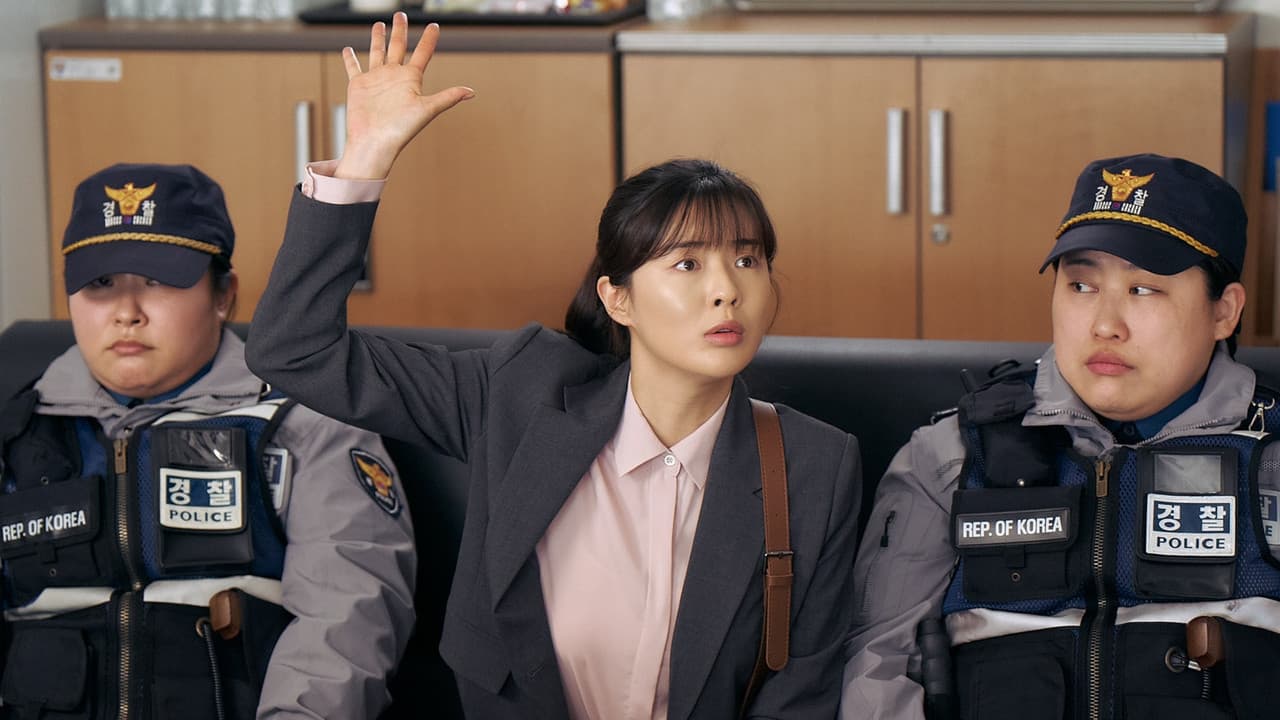
Image via TMDB Lee Sun Bin is about to be locked in a room for 40 days, and if the new stills for Ugly Duckling Ms. Maeng are anything to go by, it is going to be a pressure...
Image via TMDB
📺 Trailer: [EngSub] Ugly Duckling Ms. Maeng (2026) | Korean Movie | Main Trailer · Chingu Network on YouTube
Lee Sun Bin is about to be locked in a room for 40 days, and if the new stills for Ugly Duckling Ms. Maeng are anything to go by, it is going to be a pressure cooker of ego, ink, and existential dread. The film, which hits theaters nationwide in South Korea on October 28, has just unveiled a fresh batch of promotional images that lay bare the chaotic heart of its premise: a small-town Korean language teacher accidentally becomes part of the elite team responsible for writing the country’s most high-stakes exam, the College Scholastic Ability Test, or CSAT. It is a premise that sounds like the setup for a farce, but the visual language of these new stills suggests a comedy with genuine teeth. The core question the film poses is deceptively simple yet terrifyingly complex: can a group of strong-willed, often contradictory intellectuals actually work together to create "problem-free questions" without a single typo or room for dispute? The answer, judging by the tension in the frames, is going to be messy.
The Accidental Intruder
At the center of this academic storm is Maeng Bo Ram, played by Lee Sun Bin. The character is described as an enthusiastic teacher from a provincial town who joins the question-setting headquarters due to a simple administrative error.
In the new stills, she is not hiding in the background. She is raising her hand, voicing her opinions, and standing out like a sore thumb among the veteran writers.
This dynamic is where the film finds its comedic engine. You have a younger-generation teacher who likely operates on instinct and passion, clashing with a committee of seasoned professionals who have spent decades perfecting the art of the standardized test.
The contrast is immediate and visual. While the veterans likely view the exam as a sacred, sterile process, Bo Ram represents the human element that the system often tries to erase.
Her presence in the sealed-off headquarters is less about her writing ability and more about how her boldness disrupts the established hierarchy. It is a classic fish-out-of-water scenario, but elevated by the sheer stakes of the CSAT.
A mistake on this exam can derail a student’s entire life, so the "error" of Bo Ram being there is not just a plot device; it is a ticking clock for the entire committee.
The stills emphasize her confidence, showing her engaging directly with the committee members. This is not a passive role.
She is an active participant in the chaos, and that is what makes the character compelling. Lee Sun Bin has a track record of playing characters who are both relatable and fiercely determined, and this role seems to lean into that strength.
The idea that a teacher from a small town is now holding the fate of thousands of students in her hands, simply because a file was misfiled, is the kind of absurdity that works best when played with sincerity rather than mockery.
The film appears to take the premise seriously enough to let the humor arise from the characters' reactions rather than from slapstick.
A Room Full of Egos
Surrounding Bo Ram is a cast of characters who are as distinct as they are difficult. The new stills introduce us to the supporting players who will make or break the committee’s progress.
There is Na Eun Mi, played by Hwang Bo Ra, a Korean literature professor who lives and breathes fashion. In one image, she is clasping her hands in admiration while looking at a screen displaying a question she has written.
This detail is crucial. It tells us that for her, the exam is not just a job; it is a canvas.
She is an artist who happens to be writing multiple-choice questions. Then there is Professor Ye, played by Jung Soo Young, an aesthetics professor who studied in France.
He is captured mid-gesture, enthusiastically explaining something. His presence suggests a layer of intellectual pretension that will likely clash with the pragmatic needs of the exam writers.
He is there to make the questions beautiful, or at least aesthetically pleasing, which is a luxury the CSAT committee cannot afford.
On the other side of the table is Kang Ji Hye, played by Lee Jin Hee, a veteran question writer who has served on the committee five times. In the stills, she is deep in thought, studying another member’s question.
This is the anchor of the group. She knows the rules, she knows the pitfalls, and she knows what it takes to survive the 40-day lockdown.
Her experience is the counterweight to the chaos. Then there is the rivalry.
Park Kyung Tae, played by Kim Young Min, heads the review committee, and he is reuniting with his longtime rival Moon Joo Yeol, played by Yoo Jae Myung, who heads the Korean language question-setting committee. The stills show Moon Joo Yeol abruptly rising from his seat to engage in a tense argument.
This is not a workplace where people nod politely. This is a battlefield.
The tension between these two men is likely the primary source of conflict, and it will force the other members to take sides or find a way to mediate.
Adding to the mix are Go Jae Bong, a philosophy professor who is cautiously glancing to the side, and Hwang Si In, a schoolteacher and poet who won a literary award for her debut poem.
There is also Ki Jun Soo, played by Jeon Seok Ho, an evaluation institute employee who is a master of workplace social skills. This last character is particularly interesting.
In a room full of academics who are likely more comfortable with ideas than people, a master of social skills is a wildcard. He knows how to navigate the office politics that will inevitably arise when 40 days of isolation sets in.
The stills show the committee members passionately exchanging ideas in front of a whiteboard, but the underlying current is one of friction. Everyone has a different vision of what a "problem-free question" looks like, and that disagreement is the fuel for the film.
The Stakes of the Suneung
To understand why this comedy works, you have to understand the weight of the CSAT. In South Korea, the Suneung is not just an exam; it is a national event.
It is a day when the entire country holds its breath. The questions must be perfect.
They cannot be ambiguous. They cannot have typos.
They cannot be biased. The pressure on the writers is immense, and the film taps into that anxiety.
The 40-day deadline is a hard constraint. They are sealed off in a headquarters, working in complete secrecy.
There is no escape. There is no outside world.
Just the questions, the people, and the clock. The stills show a pack of ginseng juice being presented to Moon Joo Yeol, described as his "secret weapon." This small detail adds a layer of human vulnerability to the otherwise rigid academic setting.
Even the toughest rivals need energy, and even the most confident professors have their limits. The film is using the high-stakes environment of the CSAT to explore how people behave when they are trapped together with their egos and their insecurities.
The release date of October 28 places this film in a competitive slot, but the premise is uniquely suited to the current appetite for workplace comedies that take their settings seriously. It is not just a story about teachers; it is a story about the systems we rely on and the humans who build them. The new stills suggest a film that is visually dynamic, with characters who are fully realized and distinct. Lee Sun Bin’s Maeng Bo Ram is the catalyst, but the ensemble cast provides the resistance. The question is not whether they will finish the exam on time; it is whether they will survive the process. The answer will be revealed in theaters on October 28, and based on the tension in these images, it is going to be a wild ride. For fans of sharp, character-driven comedies that understand the pressure of high-stakes environments, this looks like a must-see. The chaos behind the scenes is just as important as the final product, and Ugly Duckling Ms. Maeng promises to show us exactly how messy that chaos can be.
Sources & references
- Primary source: Soompi (K-drama) — Lee Sun Bin, Yoo Jae Myung, And More Unveil The Chaos Behind CSAT Question-Setting In “Ugly Duckling Ms. Maeng”
Facts are credited to the sources above. Images and trailers belong to their respective owners and are used for editorial commentary.
Email edition
Liked this? Get the next one by email.
One concise edition a week: the reviews, trailers and watch guides worth your time.
Written by
The pracandyFlix Desk
pracandyFlix editorial contributor covering movies, streaming and the craft behind popular storytelling.
Comments
- No comments yet. Be the first.